
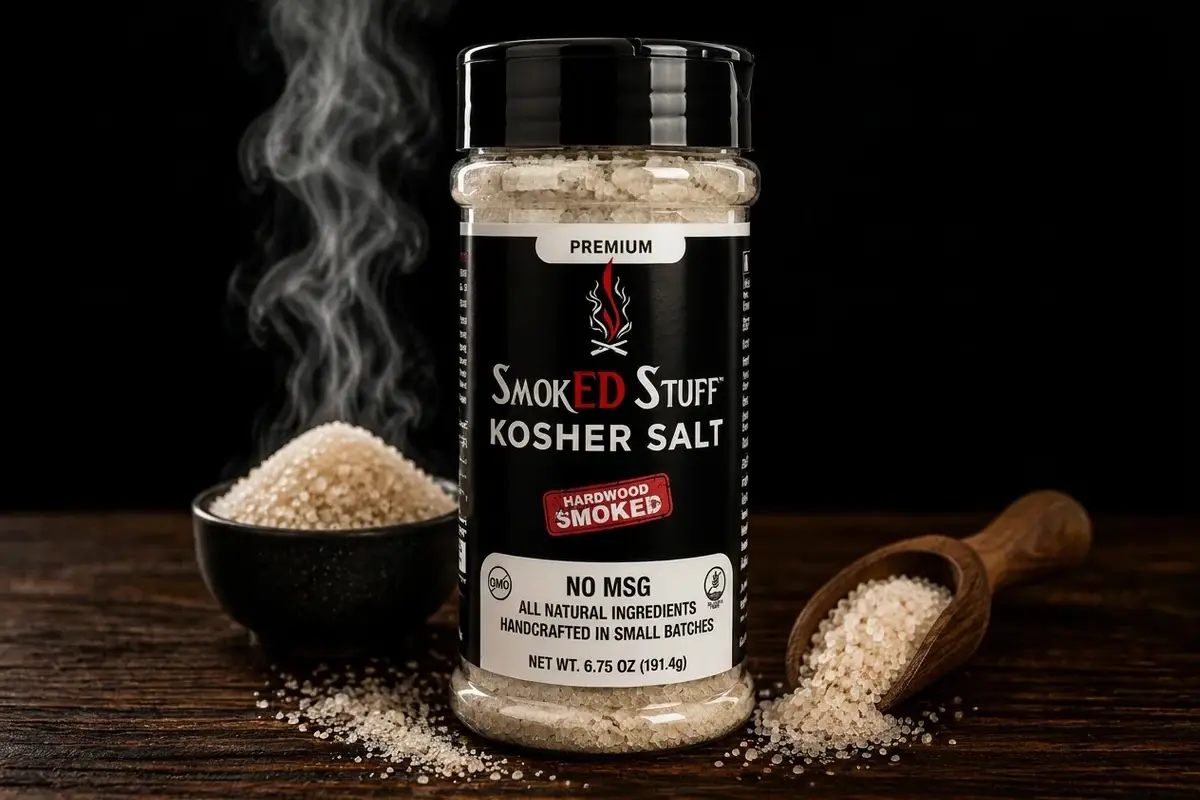

To smoke salt, spread coarse or flake salt in a shallow layer, run hardwood smoke over it at a cold-smoking temperature (low enough that nothing cooks) or in a low smoker, stir it regularly, and stop when the aroma and color are where you want them. The smoke only adds flavor. Your salt won’t get saltier, and it is not a preservative.
What this article covers
- What Smoking Does to Salt
- Choose Salt That Can Catch the Smoke
- Match the Wood to the Food
- Set Up the Smoker Safely
- How to Smoke Salt Step by Step
- Real Smoke and Liquid Smoke Are Different Methods
- Store and Use the Finished Salt
What Smoking Does to Salt
Give salt time in the smoker and its aroma deepens, while the color might shift from white toward cream, tan, or light brown. Then use it wherever you want a wood-fired note: at the table after cooking, or on food you never took outside.
Treat smoked salt as a seasoning, though. Smoke by itself will not preserve food, so it does not replace safe curing, refrigeration, or other food-handling practices. Penn State Extension’s guidance on smoking and preserving treats wood smoke and approved liquid smoke the same way: as sources of flavor, not preservation.
How much smoke flavor you end up with starts with the salt you choose.
Choose Salt That Can Catch the Smoke
Start with coarse kosher salt, coarse sea salt, or flake salt. The bigger crystals stack loosely, so far more surface stays exposed to the smoke than with tightly packed fine salt. Flake salt is the one to pick when you also want a finishing salt, because those broad crystals stay visible on the food. And coarse salt is easier to stir without pushing it through your tray or screen.
Whatever you choose, use plain salt with no added flavoring. If you want to compare your batch with a ready-made version, try our Smoked Kosher Salt. It’s made the same way you’re making yours, with real hickory smoke over plain kosher salt and nothing else.

Match the Wood to the Food
You’ll make nearly every batch with one of these four woods:
| Wood | Smoke Character | When to Use It |
|---|---|---|
| Hickory | Bold, familiar barbecue smoke with a slightly sweet edge | An all-purpose smoked salt for beef, pork, beans, and roasted vegetables. |
| Oak | Steady, rounded smoke that is less assertive than hickory | When you want a versatile salt without the wood being the loudest flavor. |
| Mesquite | Strong and earthy | Smaller batches, used lightly on beef, chili, and other robust dishes. |
| Fruit woods | Lighter and sweeter | Apple or cherry for poultry, vegetables, and finishing salt. |
Hickory is our favorite because it has a clear smoke character without a heavy application. It’s also the wood we started with. The whole company started with one grocery-store label. The jar said “smoked,” but the ingredient list said smoke flavoring, and nothing in it had ever been near a fire. So we began smoking real ingredients ourselves and sharing batches with neighbors. That standard hasn’t changed. We use smoke as a process, and we keep the label understandable.

Whichever wood you pick, the setup it burns in has to be food-safe.
Set Up the Smoker Safely
Smoke your salt in equipment made for cooking: a smoker, a grill, a smoke tube (a pellet-burning tube that makes smoke without much heat), or a cold-smoke setup. Do not use containers that were never meant for cooking. Coatings, paint, or unknown metals can end up in your food. The USDA’s smoking safety guidance gives the same warning.
For bigger crystals, a rimmed sheet pan is all you need. For fine flakes, use a stainless mesh tray so they don’t fall through the grate. You can find smokers, smoke-generating accessories, and barbecue tools at DDR BBQ Supply, a barbecue retailer that stocks the major brands. Whatever your setup, spread the salt thin rather than piling it deep. Smoke only flavors what it touches.

How to Smoke Salt Step by Step
These six steps take you from plain salt to a finished jar:
- Spread the salt about 1/8 to 1/4 inch deep on a clean metal pan or fine mesh tray, breaking apart any clumps so the smoke reaches every crystal.
- Start the smoke. Thin, almost invisible smoke gives a clean flavor, while thick white smoke turns the salt bitter. Cold smoking works best because there’s no heat to manage, but a smoker on its lowest setting also works, since salt won’t cook like meat.
- Place the uncovered tray where smoke can circulate above and around it. Keep it away from dripping food, grease, or direct flame.
- Stir or rake the salt every 30 to 60 minutes, turning the lower crystals onto the surface and smoothing it back into a thin, even layer.
- Begin checking the aroma after two hours. A typical batch needs several, and a deep hickory profile might take considerably longer.
- Remove the tray and let the salt cool completely in open air. Transfer it only after it is cool and dry.
Watch the color for progress, not for doneness. Woods and smokers differ, and some salt stays fairly pale no matter how much flavor it’s picked up. So smell a small spoonful away from the smoker air, then taste a few crystals. Your salt is done when you can name the wood without any bitter, ashy, or overpowering edge.

All of this assumes that you’re using real wood smoke, but there’s also the shortcut in a bottle.
Real Smoke and Liquid Smoke Are Different Methods
Liquid smoke adds smoke flavor without a smoker, but it’s an ingredient that you apply to the salt, not smoke produced around the crystals. If you use it, follow the product label and mix a small amount evenly through the salt, then spread the damp salt on a clean tray and let it dry fully before storage. Don’t pour freely from the bottle, because the concentrated flavor can quickly take over a batch.
Real wood smoking takes longer, but you choose the exact wood profile. Liquid smoke is faster and works when outdoor smoking isn’t practical. Read the ingredient label either way. Our clean-label position is that when it’s sold as wood-smoked, the ingredient itself should have gone into the smoker rather than relying on “smoke flavor” added afterward. We take the same process-first approach with every smoked ingredient and blend we sell.
Either way, a finished batch only stays good if you store it right.
Store and Use the Finished Salt
Keep smoked salt in a clean, airtight jar in a cool, dry cabinet. Spoon it out rather than shaking the jar over a hot pan, because the steam coming off the pan makes salt clump. Label each batch with the salt, wood, and date, and you’ll find the next batch much easier to adjust.
Use your smoked salt anywhere a final hit of smoke makes sense: grilled steak, eggs, roasted vegetables, or a bowl of tomato soup. You get more control over the final saltiness from a small pinch at the table than from salting heavily during cooking.
Smoked salt also works alongside seasonings you buy for a different job. With our Salt Free Rubs, you control the salt yourself, and the Smoked Birdie Rub is an option when you want a prepared poultry seasoning. Keep your homemade salt separate until you taste the food, then add only what the dish needs.
However you use it, the salt still counts toward your daily sodium, and the FDA cites a recommended limit of 2,300 milligrams per day for people age 14 and older in its consumer guidance on food ingredients.
Don’t expect your first batch to be your best. Smoke a small amount, write down the salt, the wood, and the time, and adjust the next round from what you taste. It’s the same process we use, with real wood, plain salt, and a label you can read.
Frequently asked questions
Can I Smoke Salt in a Pellet Smoker?
Yes. Use a shallow metal or mesh tray on the lowest practical setting, and keep the salt away from grease and drippings. Stir it now and then, because airflow and smoke vary across the chamber.
Can I Smoke Two Types of Salt at Once?
Yes, but on separate trays. Flake and coarse salt expose different amounts of surface, so one might reach the flavor you want first.
Why Does My Smoked Salt Taste Weak?
Usually one of three things: the layer was too deep, the salt wasn’t stirred enough, or the smoke was too light. Spread the next batch more thinly and taste it away from the smoker air before deciding whether it needs more time.
Should I Grind Smoked Salt Before Storing It?
Store it in its original crystal size and grind a small amount only when a recipe needs finer seasoning. That way you still have the large crystals for finishing.